
July 2025
Quick Facts
- The call number is the "address" of the book. It shows the location of book on a library shelf.
- Numeric titles and authors will be shelved before alphabetical titles and authors.
- Call numbers such as URBAN 50CENT, FICTION 21, or DVD Drama 1917 will be shelved before the "A"s of their collections.
- Numerals will be shelved by the first character, then by subsequent characters.
- Spaces and non-alphanumeric symbols will be ignored.
- Call numbers with a number spelled out (such as DVD Drama FORTY) will be shelved alphabetically.
- IMMS Quick Guide-Shelve Items at a Branch
- CEN Call Number and shelving Overview Doc
- Chaotic storage and shelving at OPS
Jump to:
- Fiction
- Numerical Authors and Titles
- Nonfiction
- Nonfiction Graphic Novels
- Biographies
- Reference Nonfiction
- Shakespeare
- World Language Collection
- Children's and Young Adult Nonfiction
Call number overview
Fiction
-
Fiction is shelved in strict alphabetical order by author’s last name, then first name and then each author’s works are alphabetized by title (ignore A, The, & An when these begin a title).
-
For series by the same author books are shelved alphabetically by title, not in the series order. This may result in books from the same series not being next to each other.
-
The shelving of materials authored by Mac and Mc names is also in strict alphabetical order.
-
Example: Maas, MacDonald, Malley, McDonald, Mellon.
-
-
Authors’ names with prefixes are shelved by the first letter of the prefix and then the rest of the name, omitting the spaces between them.
-
Example: Mazo De La Roche is shelved as “Delaroche”; Lynda La Plante is shelved as “Laplante”.
-
- Ignore any punctuation in an author’s name. Thus, Darcy O’Brien is shelved as “Obrien”.
- Example: Oates, O’brien, Ocampo, O’connor.
- In the case of Saint vs St., follow the label.
- Example: Saint-Exupery would be shelved as SaintExupery. St. James would be shelved as StJames.
- Authors’ names that are abbreviated as a single letter are shelved as if the letter was the entire first name.
- Example: H.D. comes before Haake, Katherine; and Madison, A.W. comes before Madison, Aaron.
- Author's with multiple last names are shelved by the first one listed.
- Examples: Gabriel Garcia Marquez is shelved as "Garciamarquez" and Dick King-Smith is shelved as "Kingsmith".
- Books with multiple authors shelved by the first one listed. Ignore any other Author names.
Numerical authors and titles
- Numerical authors and titles are shelved numerically.
- Shelve numeric authors and titles before alphabetical authors or titles.
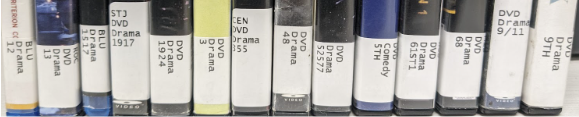
- Call numbers such as URBAN 50CENT, FICTION 21, or DVD Drama 1917 will be shelved before the “A”s of their collections.
- Numerals will be shelved by the first character, then by subsequent characters.
-
Example: 52577 comes before 5TH, because the second character of 52577 is a number and the second character of 5TH is a letter (see below).
-
- Spaces and non-alphanumeric symbols will be ignored.
-
Example: 9/11 will be shelved as 911 (see below).
-
- Call numbers with a number spelled out (such as DVD Drama FORTY) will be shelved alphabetically.
Nonfiction
The call number consists of two parts: the Dewey number and the Cutter number. The Dewey number designates the subject, and the Cutter number designates the individual book.
- The first three digits of a call number denote the general subject.
- The numbers after the decimal point refer to a more specific subsection of the general subject.
- The letter that begins the Cutter number is the first letter of the Author’s last name.
- The number that follows the letter is a numerical representation of the rest of the Author’s name.
- The final letter in the Cutter number is the first letter of the title of the book.
Note that the Dewey system uses whole numbers and decimal numbers. Treat numbers in the Cutter number as decimal numbers.
Examples of Dewey order:
523.1 H394u 2001
523.1 H394u 2002
523.1 H919c 1997
523.1 H98c
523.2 H361d
Nonfiction Graphic Novels
For some graphic novels there is no Cutter number and instead is the author's name. Shelve items with the author's name spelled out before ones with cutter numbers.
Example:
jgn 398.2 Limke
j 398.2 L129f
Biographies
Biographies are arranged in their own run by Dewey number, then the name of the subject: Monarchs and Saints by first name, all others by last name.
Biographies are sorted by call number, then alphabetically, and then by the date after the subject’s name. If we have multiple editions of the same book, but with a different printing date, those books still go in order by date:
BIO 641.5 BOURDAIN 2007
BIO 641.5 BOURDAIN 2010
BIO 641.5 CHILD 2006
BIO 641.5 CHILD 2007
There are biographies located in other areas as well; i.e.: actors, musicians, and athletes may be cataloged with regular call numbers and filed with film books and sports books respectively.
Reference Nonfiction
Reference items cannot be checked out unless approved by a librarian or supervisor. They are marked with one of the following reference letters which precede the call number on the spine label:
R – General Reference.
O – Oregon Collection. By and/or about Oregonians and Oregon.
W – Wilson Collection. John Wilson left us his library in 1903 on the conditions that the items cannot leave this building and that this must be a public library. Some of these items are in Central’s rare books room, which is named for Wilson.
Shakespeare
Shakespeare books are cataloged with more than one letter and no numbers (except years) in the Cutter number.
Examples:
822.33 BChs
822.33 Bdu
822.33 ChaL
822.33 Ck
822.33 Dbam
822.33 Dhami 2003
World Language Collection
Books in other languages are filed in alphabetical order by the English name of the language. Each language is assigned a one or two letter abbreviation. Examples: Ab = Arabic; F = French; K = Korean; Ru = Russian. Newer books have the full English name of the language spelled out on the label.
Nonfiction in other languages is cataloged in the same way as the rest of the collection. The only difference is that the call number is preceded by the abbreviation or the name of the language. Example: Ab- 641.595 F213.
There is an exception to this rule. Some are cataloged with the Author’s name in place of the Cutter number. Example: Ch- 641.5951 FANG, XUMING.
Fiction in other languages is cataloged in two different ways: Older books have what is basically a Cutter number instead of the Author’s last name. Example: V-C97225c – Author is Cung, Khanh. Newer books have the Author’s name on the label. Example: VIET-Nguyen, Ho. They are shelved in alphabetical order, thus the ones cataloged with the full name are shelved after the ones with the Cutter number-style name.
Examples:
V-N577v
V-N812L
VIET-Nguyen, Ho
VIET-Nguyen, Ngo
Children's and Young Adult Nonfiction
Children’s and YA materials are cataloged and shelved the same as their adult counterparts. The call numbers are preceded by a “j” or a “Y” respectively.